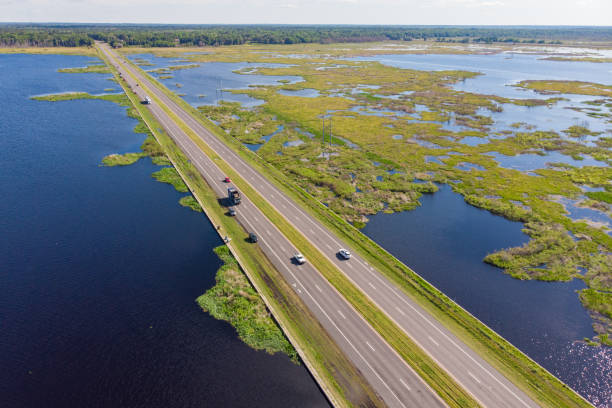
I am a proud Florida Native. As you can see from my posts, I am concerned about the nature of my home state, as well as the rest of the natural USA. There is a part of Florida we are protecting at all costs before the greedy developers get their hands on it. Thankfully, we still have 60% of the Everglades left (grassy waters), which are slow-moving rivers surrounded by swamp land.
There is a corner of Florida that exists in defiance of everything the state has become. Here, where the land rises in gentle waves toward the sky, where alligators glide through marsh waters as they have for millennia, and where wild horses still roam free against a backdrop of sawgrass stretching to the horizon, you can still find the Florida that existed before the mouse became king. This is Paynes Prairie, a 21,000-acre preserve that stands as both testament to what Florida once was and a stark warning about what stands to be lost.
A Landscape That Remembers
Paynes Prairie is not merely a nature preserve, though it is certainly that. It is a living archive of the Florida that existed before the dream of Disneyland transformed this peninsula into a theme park empire. To walk its trails and boardwalks is to step backward through time, to a period when the word “Florida” conjured images not of overcrowded attractions and traffic jams, but of vast wilderness, of ecosystems so rich and complex that early explorers struggled to find words adequate to describe them.
The prairie itself sits in a shallow basin that was once the bed of an ancient sea. When the waters receded, they left behind rich sediments that have made this landscape extraordinarily fertile over thousands of years. Ancient peoples recognized the land’s gifts long before European settlers arrived—the prairie was a gathering place, a hunting ground, a source of the abundance that sustained civilizations here for centuries. ThePaynes, the family for whom the prairie is named, were among the early settlers who recognized something special about this place, who chose to make their home in a landscape that offered not the false promises of Florida’s development boom but something far more valuable: genuine natural wealth.
Today, the prairie is managed by the state of Florida, protected within the boundaries of Paynes Prairie Preserve State Park. But protection, as we shall see, is a fragile thing in a state that has built its entire economy on the worship of growth and the worship of the dollar.
Wildness Preserved
The wildlife of Paynes Prairie offers a compelling argument for the value of preserving wild spaces in an increasingly wild world. This is a place where alligators still rule the waterways, where they bask on the banks of alligator-filled ponds with the unhurried confidence of creatures who have never learned to fear humans. In the winter months, when northern LakesWinter birds arrive in vast numbers, the prairie becomes one of the great birdwatching destinations on the continent. Herons stalk the shallow waters. Eagles nest in the tall pines that dot the preserve’s edges. Sandhill cranes wander through the grasslands in family groups, their prehistoric calls echoing across the flat landscape like voices from another age.
But perhaps the most evocative inhabitants of Paynes Prairie are its wild horses. These animals, descended from horses brought to Florida by Spanish settlers centuries ago, have persisted here even as their kind disappeared from virtually every other corner of the eastern United States. To see them—shaggy, sturdy, moving with an easy grace across the prairie grass—is to glimpse something that once covered the entire southeastern plain. They are living ghosts, reminders of a Florida that existed before fences and freeways and the ceaseless appetite of development transformed every acre of available land into real estate.
The bison, too, have returned to Paynes Prairie in recent years, part of an effort to restore the large grazing animals that once shaped this ecosystem. Watching these massive creatures move through the grasses, you understand on a visceral level how different this landscape is from the Florida of strip malls and subdivisions. This is not a place designed for human convenience. This is a place that simply exists, as it has existed for thousands of years, according to laws and rhythms that have nothing to do with quarterly profits or housing markets.
The Florida That Was
There was a time when what we see in Paynes Prairie covered much of Florida. The peninsula was a landscape of vast prairies and cypress domes, of springs that bubbled up in crystalline abundance, of rivers that ran clear and cold through wilderness that seemed, to early observers, almost limitless in its extent. The naturalist William Bartram described Florida in terms that seem almost hallucinatory in their richness, writing of forests so dense that noon appeared as dusk, of prairies black with grazing animals, of ecosystems so intricate and interconnected that they seemed to breathe and pulse with a single vast life.
That Florida is gone, most of it, disappeared beneath the infrastructure of modern civilization so thoroughly that many Floridians today have no idea that it ever existed. They grow up in air-conditioned homes, drive on multi-lane highways, visit theme parks that offer sanitized versions of “adventure” and “wildness” that bear almost no relationship to the actual wildness that once covered this land. They have no idea that the ground beneath their feet once hosted creatures now found only in memory, that the waters that flow beneath their taps once emerged from springs clear enough to see the bottom, that the air they breathe once carried the calls of millions of birds rather than the exhaust of millions of cars.
Paynes Prairie survives as a relic, a piece of that lost Florida preserved through a combination of geography and luck and the efforts of people who recognized its value before it was too late. But relic is a dangerous word. Relics are things that exist in the past, that speak to us across an unbridgeable gulf of time. And Paynes Prairie, for all its historical significance, is not a relic. It is a living ecosystem, a functioning wilderness, a place where the old Florida still breathes and grows and, in its own way, persists.
The question that haunts anyone who spends serious time in this place is how long that persistence can continue.
Stop The Greedy Developers
Florida is not a state that has historically valued its natural heritage. The state’s entire modern identity has been built on transformation, on the deliberate and systematic replacement of the wild with the developed. This is a place where wetlands were drained with industrial efficiency, where forests were clear-cut without a second thought, where rivers were channelized and springs were covered over and wildlife was displaced with an enthusiasm that sometimes seems pathological in its intensity. The Florida motto might as well be “There is no ecosystem that cannot be paved over.”
And make no mistake, that appetite has not diminished. If anything, it has grown more urgent, more ravenous, as Florida’s population continues to climb and developers look at the last remaining wild spaces with the calculating eyes of predators. The pressure on Paynes Prairie is constant and increasing. Every year, more housing developments spring up on the preserve’s edges. Every year, the roads that lead to the prairie carry more traffic, more visitors, more demands on an ecosystem that can only absorb so much. Every year, the water that feeds the prairie is diverted, polluted, or claimed by the growing populations that surround it.
The politics of conservation in Florida are not encouraging. The state has a long and storied history of sacrificing environmental protection at the altar of growth, of prioritizing development over preservation, of listening to the voices of builders and realtors while ignoring the warnings of scientists and environmentalists. The boundaries of protection that exist today could be redrawn tomorrow if the political winds shift. The funding that maintains the preserve could be diverted to other purposes. The protections that keep this land wild could be weakened or removed entirely.
This is not paranoia. This is the reality of Florida, a state where the natural environment has been under assault since the first European settlers arrived and where that assault has only accelerated in recent decades. The Everglades, that immense and irreplaceable ecosystem, has been dying for generations while politicians and developers argued about how much of it could be sacrificed without causing a complete collapse. The springs that once made Florida famous are dying by the dozens, victim of overpumping and pollution. The coastlines that support some of the richest marine ecosystems in North America are being developed with little thought for the consequences.
In this context, the survival of Paynes Prairie seems almost miraculous. But miracles, as the saying goes, are not sustainable. At some point, unless something changes dramatically, the pressure will become too great. At some point, the developers will win. At some point, the prairie will fall.
A Call to Witness
And so I come to the purpose of this writing, which is not merely to inform but to urge, not merely to describe but to invoke. Paynes Prairie exists today. The wild horses still roam. The alligators still bask. The cranes still call across the grasslands as they have called for thousands of years. But “today” is a narrow slice of time, and what exists today may not exist tomorrow, may not exist next year, may not exist in the lifetimes of our children and grandchildren.
If you have any love for wildness, any appreciation for the history of this nation and this state, any sense of what Florida was before it became the theme park capital of the world, then you need to see Paynes Prairie. You need to walk its trails and feel the presence of something older and stranger than the Florida you thought you knew. You need to stand in the prairie grass as the sun rises over the marsh, painting the water gold and pink, and understand that this is what this land looked like before the tourists came, before the hotels rose, before the dreams of Mickey Mouse transformed everything.
This is not an argument against Disney World, not really. Disney World is there, and it will remain there, and millions of people will continue to visit it and find whatever it is they find there. But there is another Florida, a Florida that existed before the mouse, and it is slipping away. Paynes Prairie is your last, best chance to see it—to see what Florida actually looks like when left to its own devices, when human ambition takes a day off, when the land is permitted simply to be what it has always been.
The wild horses cannot defend themselves against the developers’ lawyers. The alligators cannot petition the legislature. The prairie grasses cannot lobby for their own preservation. If Paynes Prairie is to survive, it will be because people who love it fought for it, because visitors left with memories that demanded sharing, because enough voices rose up to say that some things matter more than profit, that some landscapes are too valuable to pave over, that some wildness deserves to persist.
The Race Against Time
I think often of a photograph I once saw, taken in the early 1950s, of a Florida that no longer exists. It showed a two-lane highway stretching through a landscape of longleaf pines and wiregrass, of clear streams and open understory. The road looked peaceful, almost empty. The land on either side looked wild and empty in the way that land can only look wild when it has never known the touch of development. And I think of what that same landscape looks like today, because I have driven through that area, and I know what has happened to it. Where the photograph showed wilderness, I saw subdivisions. Where the photograph showed a clear stream, I saw a canal lined with seawalls. Where the photograph showed a Florida that time had forgotten, I saw a Florida that time had thoroughly transformed.
That transformation is still happening. The photograph I describe could be taken of Paynes Prairie today—if we are lucky, if we work hard, if we refuse to let the wild spaces disappear without a fight. But in ten years, in twenty years, in fifty years, what will remain? Will the prairie still host its wild horses, or will they have been displaced by housing developments and strip malls? Will the alligators still rule the waters, or will those waters have been channelized and polluted beyond recognition? Will the cranes still call across the grasslands, or will their voices have been silenced by the roar of lawn mowers and the hum of air conditioners?
These are not idle questions. In Florida, wild places have been lost before, and they will be lost again unless people care enough to prevent it. Paynes Prairie is not immune to this history. It is not protected by some magic barrier that keeps the forces of development at bay. It survives because people fought for it to survive, and it will continue to survive only as long as people continue to fight.
An Invitation
So I invite you, reader, to make the journey. Pack your camera and your binoculars and your sense of wonder. Drive to central Florida, and when you see the sprawl begin to thin and the prairie open up before you, know that you are entering something rare and precious. Walk slowly. Look carefully. Breathe deep the air of a Florida that remembers what it once was. Listen for the calls of the sandhill cranes and the splash of the alligators and the soft thud of bison moving through the grass. Watch the wild horses as they have always watched the prairie, with the calm patience of creatures who belonged here long before we arrived and who will, if we let them, belong here long after we are gone.
This is Paynes Prairie. This is the Florida that was. See it while you still can.