Tucked just east of Ocala in the heart of Marion County, Silver Springs State Park welcomes visitors today with the promise of glass-bottom boat tours and crystal-clear springs so transparent that sunlight penetrates to the sandy bottom dozens of feet below the surface.
Families come to escape the Florida heat, children press their faces to the glass viewing boxes as fish glide through the submerged world, and nature lovers paddle kayaks down the Silver River watching for otters and turtles. It is, by all accounts, one of Florida’s natural treasures—a place where the ancient Floridan Aquifer bubbles up through the earth in a display of geological power and optical majesty.
But those glass-bottom boats tell only half the story. Before Silver Springs became a preserve of natural wonder for tourists and families, before the monkeys became the star attraction for visitors hoping to catch a glimpse of their fuzzy silhouettes in the oak and cypress trees, this was something else entirely.
Silver Springs was one of the most important and unusual film locations in American cinema history—a Hollywood secret hiding in plain sight across the rolling hills of North Central Florida. For decades, its incomparably transparent waters enabled underwater photography that simply couldn’t be achieved anywhere else on earth, creating images that shaped how Americans imagined jungles, oceans, and the very limits of what cinema could capture.
Why Hollywood Came to Ocala
The story of Silver Springs as a film location begins with geology that Hollywood couldn’t artificial replicate no matter how much money studios threw at the problem. The Silver Springs group of springs discharges approximately 550 million gallons of crystal-clear water daily from the vast Floridan Aquifer beneath Florida’s limestone bedrock.
The result is water of near-perfect transparency—sunlight penetrates to the sandy bottom even at significant depth, revealing underwater landscapes with a clarity that tropical oceans, with their sediment and plankton, simply cannot match.
In the early days of cinema, when underwater photography was still experimental and extraordinarily difficult, Silver Springs offered something no studio tank could replicate: a natural aquatic environment where cameras could capture underwater scenes with adequate natural light and extraordinary visibility.
Studio executives and cinematographers who struggled to film underwater sequences in tanks—dealing with suspended particles, limited light, and the enormous logistical challenges of keeping equipment dry while actors performed beneath the surface—discovered that Silver Springs solved almost every technical problem they faced. The water was already there, already clear, already lit by the Florida sun.
This wasn’t a minor convenience for struggling independent productions. It was a revelation that transformed entire genres of film. Silver Springs holds the distinction of being Florida’s first major underwater film location, predating by decades the film industry infrastructure now centered in Tampa and Orlando.
Long before Florida became associated with entertainment complexes and theme parks, before the studio lots of Central Florida hummed with production activity, Silver Springs was already serving as an outdoor backlot unlike anything else on the continent. Productions came not because of tax incentives or stage facilities, but because the water itself was irreplaceable.
Tarzan Swings Into Silver Springs
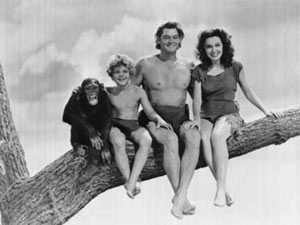
No productions are more closely associated with Silver Springs than the Tarzan films shot there during the 1930s through the 1950s—a run that includes some of the most beloved entries in the entire franchise. The actor most associated with both the role and with Silver Springs is Johnny Weissmuller, the Olympic swimming champion who became the definitive Hollywood Tarzan in the popular imagination. Weissmuller had won five gold medals and three bronze medals in swimming and water polo at the 1924 and 1928 Olympic Games before turning to Hollywood, and his extraordinary aquatic ability translated into Tarzan films that looked unlike anything else being produced in Hollywood at the time.
Where other productions struggled to make underwater sequences convincing, Weissmuller’s swimming prowess combined with Silver Springs’ crystalline waters to create action sequences that seemed to unfold in an alien world—a realm of filtered sunlight, dancing silver bubbles, and impossible grace. Tarzan might swing through jungle vines on land, but in the water, he was in his element, and Silver Springs allowed audiences to see him there with a clarity that made the fantastical seem almost documentary. The location served as a convincing stand-in for equatorial Africa throughout this era, its lush subtropical vegetation and exotic waterways providing the visual language of jungle adventure that audiences expected from the franchise. Palm trees, hanging Spanish moss, and the mysterious dark waters of the springs created a world that felt simultaneously familiar and strange—the Africa of imagination rendered in Marion County clay.
The Tarzan productions did more than create memorable cinema, however. They left a living legacy that persists to this day in the woods around Silver Springs, a legacy that has nothing to do with film stock or production sets.
The Monkeys:Tarzan’s Living Legacy
The most surprising legacy of the Tarzan productions at Silver Springs isn’t preserved on celluloid or documented in studio archives—it’s alive in the trees. During the filming era, production teams brought rhesus macaques to Silver Springs as part of the production’s exotic atmosphere. These small primates served as exotic accessories on screen, adding movement and authenticity to the jungle scenes that Silver Springs stood in for Africa. Some of these imported monkeys escaped their enclosures, finding sanctuary in the dense hardwood hammocks and cypress domes that surrounded the springs.
What began as a small population of escapees has since flourished into a thriving feral colony of rhesus monkeys—direct descendants of those escaped Tarzan-era animals—that lives in the woodlands around Silver Springs State Park. Today, spotting these clever, unpredictable creatures during a glass-bottom boat tour or kayak trip on the Silver River is one of the park’s most memorable and unexpected experiences. Visitors who arrive hoping primarily to see the famous springs and underwater world are often equally delighted—and sometimes quite startled—by the sight of monkeys leaping through the trees along the riverbanks, their reddish-gold fur catching the Florida sunlight as they survey the passing boats with obvious curiosity.
The monkeys have become so associated with the Silver Springs experience that many visitors specifically hope to catch a glimpse of them, photographing their antics from the safety of the boats or while kayaking at a respectful distance. Park rangers and naturalists offer guidance on the best times and locations for monkey sightings, while also cautioning visitors against approaching the animals or attempting to feed them. These are wild creatures, descendants of movie props gone feral, and they have retained all the instincts and unpredictability of their species. Feeding them or attempting to close the distance for a better photo puts both visitors and monkeys at risk and is strictly prohibited.
Silver Springs’ Full Hollywood Resume
The Tarzan films, though the most famous, represent only a portion of Silver Springs’ extensive filmography. The springs served as a location for dozens of productions over several decades, each taking advantage of that remarkable water in different ways.
The television series Sea Hunt, which ran from 1958 to 1961, used Silver Springs extensively for its underwater sequences. The popular show starred Lloyd Bridges as a scuba diver engaged in various underwater adventures, and its use of Silver Springs introduced millions of Americans to the sport of scuba diving at a time when the activity was still mysterious to most of the public. Children across the country watched Bridges slip beneath the surface of those impossibly clear waters, and many of them later credited the show with inspiring their own interest in diving and underwater exploration. Sea Hunt did more than entertain—it helped create the cultural phenomenon of recreational scuba that would transform Florida’s coastlines and the sport’s popularity worldwide.
Creature from the Black Lagoon, the iconic Universal horror film released in 1954, used Silver Springs for its underwater sequences featuring the Gill-man creature. The film’s memorable images of the monster gliding through crystalline water, framed by the otherworldly light filtering down through the springs, created some of the most striking visuals in classic horror cinema. The production transformed Silver Springs into the Amazonian habitat of the Gill-man, using camera angles and underwater staging that made the most of the location’s unique properties. Today, the film is remembered as one of the great monster movies of its era, and Silver Springs’ contribution to its visual power remains a point of pride for the region.
Airport ’77, the 1977 disaster film, used Silver Springs for underwater sequences depicting a submerged aircraft. The production constructed elaborate underwater sets around actual aircraft wreckage, using the springs’ visibility to create sequences that audiences could follow with clarity despite the setting’s disaster context.
The Yearling, the beloved 1946 MGM adaptation of Marjorie Kinnan Rawlings’ Pulitzer Prize novel, used locations throughout North Central Florida and contributed to Silver Springs’ reputation as a versatile location capable of standing in for environments ranging from jungle rivers to pastoral wilderness.
A Living Connection to Cinema History
Today, Silver Springs State Park operates as a preservation of both natural and cultural history. The glass-bottom boats that carry visitors across the main spring offer views of the same waters that once hosted Johnny Weissmuller’s aquatic stunts and the Gill-man’s menacing glide. The monkeys in the trees overhead provide a living reminder of Hollywood’s decades-long presence in Marion County, their presence a kind of historical artifact as meaningful as any preserved film reel or production photograph.
For visitors who come to the park without knowledge of its cinema history, the connection often comes as a delightful surprise—a layer of cultural significance that transforms a pleasant day at a state park into a pilgrimage through American film history. For those who arrive already knowing the story, the experience carries an additional dimension of recognition, of seeing with new eyes waters that have been seen by millions on screen.
The springs themselves continue to produce those 550 million gallons of crystal-clear water daily, just as they did when production crews first recognized their unique properties. The water that enabled some of cinema’s most ambitious underwater sequences continues to enable visitors to see into a world that would otherwise remain hidden—through the glass bottoms of boats, through the lenses of underwater cameras, through the eyes of children discovering for the first time that there are worlds beneath the world’s surfaces worth exploring.
Silver Springs represents something rare: a place where natural wonder and cultural history have merged so thoroughly that neither can be fully appreciated without the other. The springs created the films, the films created the monkeys, the monkeys created new traditions, and all of it together created an experience available nowhere else on earth. It is, in the end, exactly what Silver Springs has always been: a place where the impossible becomes visible, where the secret world beneath the water’s surface reveals itself to anyone willing to look.