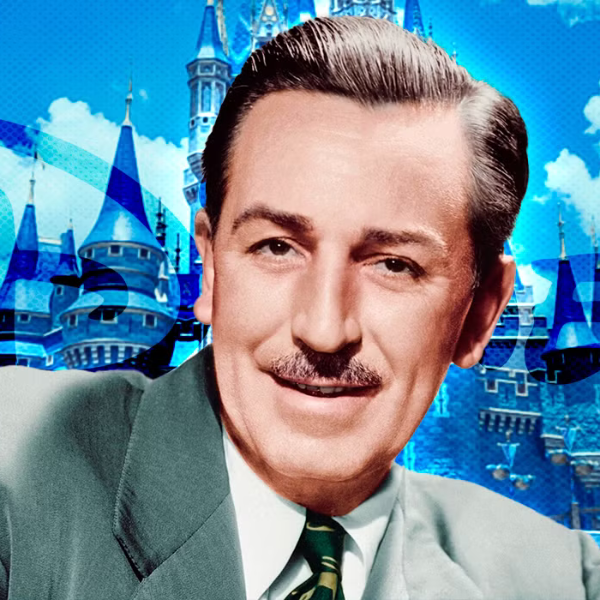
In the summer of 1965, a man named Anthony F. S.–a fictional accountant with a fictional firm–began quietly purchasing farmland in central Florida. Over the following months, this seemingly unremarkable man and his mysterious company acquired more than 27,000 acres of land through a web of dummy corporations and shell companies. The purchases were so secretive that farmers in the area would occasionally sell their property to representatives of companies whose names they couldn’t quite pin down, never knowing that they were handing over parcels of what would become one of the most ambitious development projects in American history.
When the true buyer was finally revealed on November 15, 1965, the announcement sent shockwaves through both the entertainment industry and the state of Florida. Walt Disney himself had spent roughly $5 million (the equivalent of roughly $40 million today) to assemble a property that would eventually grow to encompass more than 40 square miles–making it larger than the entire island of Manhattan. What stood in the way of his vision, however, was not just the logistics of construction or the challenges of financing. The land itself presented an obstacle that seemed almost insurmountable: thousands of acres of Florida swampland, much of it considered worthless by nearly everyone except the mosquitoes and alligators that called it home.
The Central Florida Landscape Before the Mouse
The land that Walt Disney selected for his ambitious project lay in Orange and Osceola counties, in the area surrounding the small city of Orlando. This was not the dramatic, picturesque swampland of Southern gothic novels, but something more complicated and, in its own way, more significant. Central Florida’s landscape consisted primarily of wetlands known as the Everglades drainage basin, a vast system of shallow ridges and sloughs that slowly carried water from the north toward the southern tip of the peninsula. The terrain was flat almost beyond comprehension, rising and falling by mere feet across miles of territory. The soil was sandy and acidic, poorly suited to traditional agriculture but remarkably effective at supporting thedense undergrowth and hardwood hammocks that characterized the region’s natural state.
Prior to Disney’s arrival, this land served primarily as cattle range and orange grove territory, though even these uses required constant battle against the encroaching wetlands. The area’s population was sparse, its economy modest, and its reputation among Floridians largely as a place to pass through on the way to Miami or the coast. The phrase “central Florida” carried little of the contemporary connotations of tourism, theme parks, and economic prosperity. Instead, it evoked a region that time seemed to have forgotten, where the pace of life moved slowly and the land resisted human modification with stubborn persistence.
The wetlands themselves represented a complex ecosystem that had developed over thousands of years. Cypress domes–circular concentrations of cypress trees growing from the swampy center–dotted the landscape, their knees rising from the dark water like ancient sentinels. Sawgrass stretched for miles in every direction, its bladed leaves sharp enough to draw blood from an unwary intruder. Hardwood hammocks provided dry(ish) islands of oak, palm, and magnolia, creating corridors of diverse vegetation amid the soggy expanse. Alligators ruled the waterways, their prehistoric presence a reminder that this landscape had changed little since long before European settlers arrived in Florida.
The Engineering Feasibility Problem
When Disney’s representatives first surveyed the property, they faced a question that might have doomed less ambitious projects: how does one build a massive entertainment complex on land that spends much of the year under several feet of water? The answer would require one of the most ambitious earth-moving operations in American history and would fundamentally alter the hydrology of the entire region.
The construction teams that Disney assembled approached the problem with a simple but sweeping solution: they would essentially drain the entire property. This meant digging an extensive network of canals, pumping stations, and retention ponds that would carry away the excess water and allow the sandy soil to support the weight of buildings, roads, and parking lots. The scale of this undertaking defied easy comprehension. crews moved more than 50 million cubic yards of earth during the initial construction phase, reshaping the very contours of the land. Hills were created where none had existed before, lakes were excavated from wetlands, and the natural water flow was redirected according to a carefully engineered plan.
The drainage system that Disney built beneath and around the property remains one of the most sophisticated of its kind in the world. Hundreds of miles of canals snake through the property, their water levels carefully managed by a series of pumps and control structures. The system operates constantly, pumping water from beneath the developed areas and sending it toward the network of manmade lakes that now punctuate the landscape. What once flowed naturally across thousands of acres of wetland was now channeled, controlled, and redirected according to human convenience rather than ecological necessity.
This transformation required not just engineering skill but also a certain willingness to disregard the ecological consequences of such dramatic landscape modification. The wetlands that once characterized central Florida served crucial functions in the broader ecosystem: they filtered water, provided habitat for countless species, and served as natural sponges that absorbed floodwaters and released them slowly during dry periods. By draining these wetlands and replacing them with impervious surfaces–roads, parking lots, and buildings–Disney created a landscape that behave fundamentally differently from its natural state.
The Environmental Tradeoffs
The environmental consequences of Disney’s construction project have been the subject of ongoing debate since the moment the first shovel of earth was turned. Critics point to the loss of thousands of acres of wetlands, the displacement of native wildlife, and the alteration of natural water flows that affected ecosystems far beyond the boundaries of the Disney property. The company has faced repeated accusations over the decades of polluting waterways, destroying habitat, and contributing to the decline of native species in central Florida.
The company has also faced more specific environmental controversies. In the 1990s, Disney became embroiled in a dispute over plans to build a residential community on previously undeveloped land within the Walt Disney World property, plans that would have further encroached on the remaining natural areas. Environmental groups objected strenuously, and the controversy eventually contributed to the departure of the company’s then-chief executive, Michael Eisner. More recently, Disney has made efforts to position itself as an environmental leader, setting ambitious goals for renewable energy use, waste reduction, and conservation. The company’s sprawling property now includes protected areas and wildlife corridors that would have been unthinkable during the construction era.
These later conservation efforts represent something of a reversal from the company’s earlier approach. The original Walt Disney World was built with little apparent concern for preserving the natural landscape; the goal was to create an artificial environment that would attract visitors from around the world, and the wetlands were obstacles to be removed rather than features to be cherished. The swampland that once covered central Florida was viewed through the lens of mid-twentieth-century American development philosophy: nature was something to be mastered and ordered, wetlands were wastelands waiting to be reclaimed, and progress meant transforming the natural world to serve human purposes.
Yet even the most critical observers must acknowledge that Disney’s transformation of central Florida produced effects far beyond the boundaries of the company’s property. The development that Disney sparked has made Orlando one of America’s major metropolitan areas, attracting millions of visitors and creating hundreds of thousands of jobs. The economic impact on Florida has been staggering, with tourism now representing a larger share of the state’s economy than almost any other sector. The small towns that once characterized central Florida–places like Kissimmee, Lake Buena Vista, and Celebration–have grown into substantial communities with all the opportunities and challenges that accompany rapid population growth.
The Swamp in Memory and Imagination
Perhaps the most intriguing aspect of Disney’s transformation of the Florida landscape involves the way the company subsequently incorporated that landscape into its own mythology. The original Disneyland in California had always presented itself as a carefully controlled artificial environment, a place where the real world was held at bay and visitors could immerse themselves in carefully curated fantasies. Walt Disney World, by contrast, was designed from the beginning to feel like a place that had always existed, as though visitors were entering a self-contained world rather than a constructed attraction.
This required a particular relationship to the natural environment that surrounded the property. The designers at Disney understood that the swampy character of central Florida could either be hidden away as an embarrassment or incorporated into the narrative that the company wanted to create. They chose the latter approach, designing the property’s waterways and landscaping to evoke the natural beauty of the Florida landscape even as they had fundamentally altered that landscape’s ecology. The result is a kind of environmental theater, a performed version of nature that maintains a complicated relationship with the actual ecosystems that once characterized the region.
The contrast between the Disney World that exists today and the land that preceded it grows more stark with each passing year. Today, the property features meticulously maintained landscaping, manmade lakes stocked with fish, and carefully controlled outdoor environments that offer visitors a sanitized version of tropical nature. Alligators still inhabit the waterways, but they are carefully managed; the native plants that once covered the region have been replaced by ornamental species selected for their visual appeal rather than their ecological value. The result is simultaneously beautiful and artificial, a triumph of engineering that bears little resemblance to the wetlands that once characterized the region.
A Landscape Transformed
Looking at the Walt Disney World property today, it requires a considerable act of imagination to picture the wetlands that once covered the area. The scope of the transformation has been so complete, the engineered landscape so thoroughly dominant, that the original nature of the site has been effectively erased from memory. Children who visit the parks have no frame of reference for understanding that the concrete beneath their feet was once swamp, that the carefully controlled waterways were once part of a natural system that had developed over thousands of years.
This erasure represents both an achievement and a loss. The achievement is obvious: Disney has created one of the most successful tourist destinations in human history, a place that has brought joy to hundreds of millions of visitors and generated enormous economic value for the state of Florida. The loss is more subtle but equally real: the destruction of a natural landscape that had its own value, its own ecological significance, and its own place in the broader community of life that characterizes central Florida.
Walt Disney himself did not live to see the completion of his Florida project; he died in late 1966, barely a year after announcing his plans, while the massive earth-moving operations were still underway. Those who completed the project in his absence inherited his vision but perhaps not his复杂的 relationship with the natural world. Disney had grown up in a more rural America, had spent time as a child exploring the fields and streams of Missouri, and seems to have possessed a genuine appreciation for the natural environment even as he pursued its dramatic transformation. The executives who followed him, raised in an era of increasing environmental consciousness, would eventually face the consequences of his ambitious project in ways that he never had to confront.
The swamplands that once characterized central Florida are gone now, drained and developed beyond recognition. What remains is a testament to human ambition, engineering capability, and the complex ways in which we relate to the natural world. Disney’s Florida project demonstrated both what humanity could accomplish and what it could destroy, setting in motion economic and environmental forces that continue to shape the region more than fifty years later. The mosquitoes and alligators that once ruled those wetlands have been pushed to the margins, their territory dramatically reduced by the relentless expansion of the artificial landscape that now covers thousands of acres of what was once, not so long ago, pure Florida swampland.